Sunday, 11 May 2014

'Elvis and Me' or 'Drawing a Long Bow'.

A dramatic recreation complete with hound dog.
Recently it was Elvis' birthday. On the 8th of January this year, Elvis Aaron Presley would of been 79 if he was still alive...or would come out of hiding. I clearly remember the day he died. I was 5 years old and in my first year of primary school. Even at such a young age I knew that a living treasure had died and that some things would never be the same again. A few years later I remember watching my younger brother play with his Elvis Paper Doll Activity Set and explaining to him who Elvis was, soldier, movie star, King of Rock-n-roll, and why he wore such amazing sequined jump suits. But what many don't realise is that Elvis and I have a lot in common and a connection of sorts. We are both male, singers, wear jeans and married beautiful women. I own a copy of Bubba-Hotep. He was a king and I am a Castle. I even got to impersonate him as 'The Pharaoh' in an amateur production of Joseph and his Technicolour Dream Coat back in 94.  Outside of these ties that bind me to the King, I didn't believe there could possibly be much else.  I was wrong, oh so wrong.

I strongly believe that some places on this earth are nexus points of mystical and mythic power. Places such as Loch Ness, Castle Frankenstein and Hanging Rock are places where fact and the fantastic caress each other in an intimate embrace.  I believe that in Adelaide, South Australia, Semaphore Beach is one of those places. In fact in my own life, Semaphore Beach has conspired to draw my fate together intrinsically with Elvis, the King of Rock and Roll.  You may ask 'How can that can be?' I will now tell you the fantastic tale of manifest destiny that drew us together.

The  beachside view of the Semaphore Carnival
Recently I was visiting my brother who lives not too far from Semaphore Beach. We were talking about the local seaside carnival and the vintage carousel that's been there for years. This beautiful merry-go-round has been on the Semaphore foreshore for the last for 76 years. The carousel was built in Adelaide by Len Northey in the 1920’s as was one of earliest electric powered models. With its forty handcrafted horses, it is said by some to be the largest operating carousel in Australia, beating all other takers by four wooden ponies. Originally situated at Henley Beach, the carousel was moved to the Jubilee Oval for six months during an expo in 1936 and then found a new home in it’s current location in 1938 (http://www.abc.net.au/local/stories/2008/11/09/2414408.htm). 


Me as Billy Bigelow posing on the Carousel on the bottom right with
Jo Lawry as Julie Jordon on my left.
On top of my city's sentimental love affair with the sideshow ride, I also had my own connection to the carousel. Back in 1995, my first year out teaching, I was given the lead role in the school production of Carousel. The character I played was that of a handsome carnival roustabout, Billy Bigelow, who uses his sex appeal to entice young ladies onto the ride. It's while he is working that he meets and falls in love with, Julie Jordon, and love soon blossoms. Incidentally, the role of Julie was played by Jo Lawry, at that time a final year student who's currently carving out a successful career as a vocalist singing back-up for Sting (see Jo in the Oscar winning documentary 20 Feet From Stardom (2013). However Billie and Julie's romance is frowned upon by those around them, and through a series of related circumstances, they find themselves unemployed.  Soon the couple are married and Julie falls pregnant. Upon hearing the news of his impending fatherhood, Billy is over whelmed with the responsibility of being a parent, especially if the child is a girl. This sense of responsibly misguidedly leads Billy to his tragic death in a robbery aimed at ensuring his child's financial security. Following his death, Billy finds himself in heaven with a chance to return to earth to try and guide his young daughter through to a better life.


The Semaphore Carousel

With the option of building a full size carousel well outside the meagre school production budget, the director opted to open the show with a silent film that showed the meeting of the two leads on the carousel. And so it was on one sunny afternoon that some of the cast, and a film crew from the school media department, headed down to Semaphore to film the opening sequence on the Semaphore carousel. There I was, playing a carnival roustabout for the cameras, pretending to romance my leading lady, while riding the Semaphore carousel. There I was, a cinematic legend in my own lunch time, being recorded for posterity on celluloid (well video tape anyway).

As I pondered these sweet memories, the discussion with my brother turned to the ferris wheel that is also a permanent fixture on the foreshore. As he did so, a bombshell was dropped that sent ripples through mystical realms. This ferris wheel had cradled the very royal backside of the King of Rock-n-Roll himself. Now I knew that Elvis had never performed in Australia and even if he had, a trip to Semaphore probably wasn't on the cards. So what was the story with this chunk of Elvis history? In 1964, Elvis appeared in a movie called Roustabout. The movie tells the story of a singing biker, Charlie Rogers (Elvis Presley) who gets work at a traveling carnival. After being run off the road by an angry Father (Leif Erickson) who has caught him flirting with his daughter Kathy (Joan Freeman), Charlie gets work as a roustabout at their family carnival while he waits for his bike to get repaired. It is here that he meets the tough carnival owner, Maggie (Barbara Stanwyck), who is also Kathy's mother.  (IMDb Plot: Roustabout (1964). Of the story IMDb says, 

Along the way, Charlie (who's got a chip on his shoulder about being an orphan) somehow learns about family values from this vaguely dysfunctional one (IMDb Plot: Roustabout (1964). 

It was in a scene with Freeman that Elvis rode what would become the Semaphore ferris wheel and serenaded her with the the song  It's a Wonderful World. The scenes featuring the ferris wheel were filmed in a cow paddock in Seven Oaks, California, with the King riding in carriage number 2. But how did the ferris wheel come to be at semaphore 50 Years later? It arrived in Australia in 2000 when it was featured on a barge under the Sydney Harbour bridge during New Year Celebrations. In 2004 the 12 carriage ferris wheel was given an over haul with new carriages and came to reside in its current location.
(http://www.waymarking.com/waymarks/WMBYN7_Elvis_Ferris_Wheel_from_Roustabout, https://www.portenf.sa.gov.au/webdata/resources/files/sem_bro_FINAL_PRINT_Julie2.pdf)

A few weeks later I returned to Semaphore and began to ponder these two wonderful artefacts of carnival history before me. It was there, surrounded by seagulls and sideshows, that I began to feel chills running up and down my spine.  Elvis and I were now connected by a strange cord, woven in the mystic merry-go-round that is the Semaphore Carnival. Both Elvis and I had played carnival roustabouts on film in stories that had explored the concept of the itinerants search for home and family. Both of us had ridden a carnival ride to woo our romantic leads and now these rides were only metres from each other. Both rides had searched for a home and had found it at Semaphore, ferris wheel here, carousel there. Roustabout here, roustabout there. Elvis here and me there. I even owned a copy of Joan Freeman in Friday the 13th: The Final Chapter. Could this be coincidence? I think not! Elvis and I were inextricably connected once again, separated by time but not by space. The long bow of destiny had been drawn.


Sometimes at night when I close my eyes, I begin to hear the haunting music of the carnival steam organ. Once again I am there, riding the carousel as the sun slowly sets. As my horse circles round to the front of the pavilion, I look over and see Elvis coming over the top of the ferris wheel. We both look at each other, wave and share a knowing smile, aware that we are inextricably linked forever. And on we ride, long into the night......


Saturday, 26 April 2014

Hammer's Frankenstein: The Unreliable Narrator

In 1957 Hammer Studios released their original Gothic horror hit, The Curse of Frankenstein". The film was an immediate success for the British company and spawned the Hammer Horror phenomenon. The Frankenstein legend was a goldmine that had already been well mined by the American movie studio Universal through a series of 7 films. The series, beginning with Frankenstein (1931) and concluding with Abbott and Costello Meet Frankenstein (1947), had told the ongoing story of the Frankenstein Monster. From  his creation in Germany to his apparent demise on a flaming pier in the USA, the Universal series had introduced the monster to various descendants of Henry Frankenstein, other classic monsters and finally a popular comedic team. By the end of the series the popular usage of the name Frankenstein for the monster and not a member of the Frankenstein family was being reflected in the titles. The Universal image of the monster, designed by Jack Pierce and portrayed by Boris Karloff and his successors, had become the dominant one in the public consciousnesses and would over shadow every depiction to come. This was Hammer's dilemma when they set out to produce their own adaption of the classic 1819 novel. Unable to imitate the popular but copyrighted monster make up, Hammer chose to take a very different approach to the Frankenstein legend. In lurid Technicolor, Hammer created a taught Gothic thriller which featured a homicidal monster (Christopher Lee) that, despite stitches and height, bore no resemblance to Universal's monster. However the biggest departure from Universal's take on the story was that the real monster of the piece was Baron Victor Frankenstein himself, a homicidal sociopath who is prepared to kill in the course of his quest to create life. But the quest itself proves to be a fatal one, with the monster falling through a sky light into a vat of acid and Victor being taken to the guillotine for the murder of his maid Justine (Valerie Gaunt), who had died at the hands of the Monster with a little help from the Baron.

The Revenge of Frankenstein
The film was a success for hammer and more horror thrillers soon followed. In 1958 the studio decided to follow up their 1957 hit with a new Frankenstein outing. The only problem was that both the monster and the Baron were dead, the latter dying childless. This problem was over come when The Revenge of Frankenstein (1958) made it clear that Victor had survived the guillotine via the help of a group of co-conspirators lead by a deformed prison attendant named Karl (Oscar Quitak). Three years later a certain Doctor Stein is setting up his practice in the nearby town of Carlsbruck. With parts obtained from his work at a nearby poor hospital, Frankenstein has built a new body for Karl. After an initially successful operation things quickly go wrong. Karl, in his new perfect body, receives a blow to the head and is transformed into a twisted cannibalistic maniac and the local medical council discover the true identity of Doctor Stein. Soon Karl is burned in a fire and Victor is savagely beaten by an angry mob in the poor hospital. As the authorities close in on the dying Frankenstein, his brain is transplanted by his assistant Hans (Francis Matthews) into a new body that has been constructed to resemble the original one. With his brain in a new body and the authorities finding his  lifeless corps and declaring him dead, Frankenstein flees to England with his companion Hans. The film ends with a certain Dr Franck opening up a practice in London making it clear that the story of Victor Frankenstein hadn't ended.

The Universal Deal
With the Baron know a reanimated creature himself and very much alive, it was clear that Hammer had learnt its lesson about killing it's hero off. However this could not be said of the original Frankenstein monster which had met its demise in a vat of acid and seemed to be irretrievably dead, that is until the third installment of the Hammer series went into production. In 1958 Hammer struck a distribution deal with Universal/International. One of the upshots of this was that Hammer now had permission to use elements from the original Universal horror cycle. One example of this was their version of Universal's 1931 classic The Mummy. Rather than being a straight remake, The Mummy actually drew characters and scenarios from several films in the Universal Mummy series. Outside of allowing Hammer to remake Universal's popular monster movies, this turn of events also had an impact on Hammers Frankenstein series. Now the popular image of Universal's Frankenstein Monster was no longer off limits and Hammer sought to revisit the story of the original creature. The problem Hammer faced was that the creature was now nothing but a collection of disassembled proteins in the bottom an acid bath and was obviously never coming back. How could the return of the Monster be achieved? The answer was to ignore the events of the original film and retell a whole new story.

The Evil of Frankenstein (1964)
The resulting film, The Evil of Frankenstein, did just that. Baron Frankenstein returns to his home town of Karlstaad with his assistant Hans (Sandor Elés) after being away for ten years. Broke and in need of money to further his  work, Frankenstein heads to his Castle only to find that it has been ransacked and it's contents confiscated by the powers that be. Victor tells his companion all about his initial experiment via flash back which shows Victor working alone his creature. He describes the resurrection of the creature and it's progress after. However the monster soon escapes and is hunted down and shot by farmers after it has slaughtered a herd of sheep. Victor is also shot in the arm by farmers as he tries to stop them. Shot in the head, the monster staggers around eventually falling of a cliff, lot to his creator. Frankenstein then describes how he was run out of Karlstaad, never to return until the present time ten years later. After heading into town, Victor notices some his belongings in the possession of the Burgomaster (David Hutcheson) and soon sets off to reclaim them. After confronting the Burgomaster, Frankenstein is chased by the authorities, forcing he and Hans to take refuge in a cave. They hide with the help of a local mute beggar girl (Katy Wild) who leads them to the Monster frozen in a glacier that is visible with in the subterranean ice wall. Soon the Monster is defrosted, revived, and with the help of a carnival hypnotist (Peter Woodthorpe), is brought out of a catatonic state.  Things quickly go wrong when the hypnotist sends the Monster out on a burglary spree that soon turns murderous. Before long there is a village mob seeking the monster, which returns to Frankenstein Castle only to go on a laboratory destroying rampage. The film ends with both Frankenstein and the Monster seemingly burned to death as the castle's tower collapses in a fiery blaze.

Universal's Frankenstein Hammer-style 
The Evil of Frankenstein contains many plot elements derived from the Universal movie series. The creature preserved in subterranean ice, village mobs, the monster's friendship with another outsider and an exploding castle, are amongst a few of the narrative references from the Universal cycle. This influence also extends to the visual design of the movie which presents a monster, laboratory and castle that are reminiscent of the Universal versions. This creates an interesting contrast when comparing The Evil of Frankenstein with the version of the origin story as told in The Curse of Frankenstein, a movie that set out to avoid the similarities with the Universal series and present a fresh take on the Frankenstein legend. However design and plot elements aside, the real thing that creates a contrast between the two films is the drastic contradictions in their versions of the origin story. Curse clearly presents the Monster as being dissolved in a vat of acid, making its preservation frozen in a glacier in Evil a major continuity problem with in the series.

Frankenstein Rebooted
It's apparent that Hammer intended to over look it's previous Frankenstein entries and reboot it's continuity utilizing the well known tropes of the Universal series. Truth be told, in popular consciousness, the Universal movies had replaced Mary Shelly's novel as the primary Frankenstein text and now Hammer had the opportunity to adapt that too. This, however, would be short lived, as the next three films (not counting the origin story remake, The Horror of Frankenstein (1970) would leave the original creature behind and instead continue to focus on Victor's further medical misadventures.

The Lying Baron
But from a narrative perspective, when placing the two films side by side, some interesting conclusions can be drawn that go some way towards harmonizing the continuity problems between the two films. Both films contain narrative that is told in flash back from the perspective of Victor Frankenstein. It may be that the Baron is an example of the 'unreliable narrator', a story telling device that presents a narrator who is telling a story that can't necessarily be trusted.  Frankenstein is a character who is known to be manipulative and prepared to lie to protect his own interests. In Revenge, Victor sets up a practice in the town of Carlsbruck under an alias and works in the poor hospital to harvest parts from unwitting patients. In Frankenstein Must be Destroyed (1969) he blackmails a young couple who are stealing narcotics into helping him with his latest experiment. The Baron is also a dangerous psychopath who is happy to take human life in order to further his plans. In Destroyed, Frankenstein murders a surgeon purely because he is a suitable candidate to provide a body for the brain he is trying to save. As a source of information he is hardly a reliable as his very version of events may be another endeavor to cover his tracks. This is especially the case in Curse where most of the narrative is framed as his plea of innocence in relation to the murder of his maid Justine. He claims he is not guilty of her murder, but that she met her death at the hands of the monster. Frankenstein's reflections in Curse also describe his years of experimentation, assisted by his tutor Paul Krempe (Robert Urquhart). In Evil this collaboration is not mentioned and Frankenstein's creation of the monster is presented as an individual pursuit. It can be argued that Paul had decided to cease his involvement with the experiment before the monster was activated and that in Frankenstein's ego-maniacal thinking the work was all his, which is naturally reflected in his retelling of the monsters origin.

A Tissue of Lies
The crux of the issue revolves around the death or disappearance of the monster with in the narrative. Both versions of the story relate the escape and fatal shooting of the creature. In Curse, Victor describes how He and Paul went out after the creature only to find the dead victims of it's murderous rampage. Once confronted, Paul shoots the monster in the head against Victor's protestations. However Victor goes onto explain how he retrieved the body and revived the monster once again. In Victor's flashback in Evil, he describes how, while searching for the escaped creature, he comes across a trail of dead sheep rather than human bodies. Soon he finds the creature feasting on a sheep's carcass and a policemen and two others also hot on the monsters trail. It is at this point that the monster is shot in the head, disappearing over a cliff, lost to his creator.

Although the details of Victor Frankenstein's flashbacks vary in many ways, the shooting of the monster in the head by another during the search is the consistent point between the two. I contend that within the narrative Frankenstein alters his recollection of events to suit his audience and tries to elicit the response that will aid his current circumstances. To try and piece together a series of events that helps explain the contradiction between the two accounts, one must reflect on the events outside Victor's flashbacks.

We know that prior to his impending execution for the murder of Justine, Victor appeals to Paul to back his story about Justine's death at the hands of the monster. In the flash back he is complicit in the pregnant Justine's death, locking her in the room with the monster in order to silence her after she had threatened to expose his experiments. Earlier in the same flash back Victor also pushes the elderly Professor Bernstein (Paul Hardtmuth) over the balustrade in order to use his brain in the creation of the monster. To cover his crime he makes it look like an accident, although Paul is suspicious. Victor claims that Justine was murdered by the monster but his own recollection implicates him. He says the death of the Professor was an tragic accident but his reflection reveals other wise. Frankenstein is not only the 'unreliable narrator' but the also the inconsistent narrator, revealing pieces of information that would seemingly hamper his cause rather than exonerate him. This is something that is not foreign to the character else where in the series. In Frankenstein Created Women (1967) Frankenstein openly shares information about his latest experiment, the transplanting of the soul of an executed man into the body of his dead lover, to the authorities to explain why the fugitive is homicidal. The Baron, aware of the genius of his work but blind to its horror, will at times naively share details of his grisly work under the impression that others will be won over by the brilliance of his achievements. Here, in pleading his case, he further implicates himself in other crimes. In believing that some how telling of Justine's death at the hands of his animated monster would actually exonerate him, Frankenstein has either proven his guilt to an even greater degree or merely convinced the priest he is telling his story to that he is lying or delusional.

The Facts of Fiction 
If it wasn't for the follow up story Revenge of Frankenstein it might be a reasonable suggestion that the later two points of you may be the case. In Revenge Frankenstein's abilities  to do amazing, but gruesome things is confirmed. Even his creation of the monster is some how known by the Doctors of Carlsbruck. However, how much of his story in Curse is true, and if he was lying, what really happened to the monster and Justine.

I believe the answer comes in Evil when the monster is found frozen in a glacial cave. Just as Frankenstein described at the beginning of the film, the monster had been shot and fell of the cliff only to be preserved in the ice. The monsters resurrection following his shooting, as described by Frankenstein in Curse, was a lie, a lie I believe was concocted to shift the blame for the murder from himself to his creation. The murder of Justine was the work of Baron Frankenstein himself, silenced when she threatened to expose his experiments to the authorities after he refused to marry her. I also suspect that Victor's fiancé  Elizabeth (Hazel Court) herself was accidentally shot by the Baron in the situations that surrounded the discovery of the body. In his flashback she was shot by Victor who was firing at the unseen Monster behind her. Unfortunately for Victor, Paul and Elizabeth refuse to support his concocted alibi as he has exhausted their loyalty. Death is what he deserves for his crimes and Paul refuses to corroborate any part of his story leaving Victor to appear like a deluded mad man.

With Our Thoughts We Shape the World
However Victor is rescued from the guillotine and lives to gain a reputation as a monster maker. Interestingly in Evil, he tells his assistant Hans that, rather than condemned to death for murder, he was charged with 'assaulting a police officer, resisting arrest and working against God' and run out of town. Once again Victor changes the story to suit his audience. Justine's murder is conveniently forgotten and he presents himself as the misunderstood genius returned to claim what is rightfully his. Truth be told, this is how he sees himself. He is a man above all others, a master of life and death. He is quite at ease remaking the past, remaking himself and manipulating the present to assure his man-remaking future. In Hammer's version of the tale, the Baron truly is the Monster.


Thursday, 20 February 2014

Noah's Ark Revisited


Recently it was announced in the press that an ancient Mesopotamian text had been translated by the British Museum. The text was found on a clay tablet that had been brought back from the Middle East following World War II by ex serviceman, Leonard Simmons. 
However it wasn’t until recently that Leonard's son, Douglas, decided to take the tablet to the museum and the true treasure was revealed. Upon reading this ancient texts, Dr Irving Finkel, Assistant Keeper of the Department of the Middle East at the British Museum, realised that here was an important find. The text (Cir.1850 BC) was an ancient account of the flood story, the most famous of which is the account of Noah and the Flood in the Hebrew Bible (http://www.dailymail.co.uk/news/article-2524056/Noahs-Ark-coracle-reeds-bitumen-reveals-Babylonian-text.html). Many of the details given in the text are similar to those found in the Bible and other ancient accounts of the flood story, however this one contained something new. The remarkable thing about the 3700 year old text  is that it presents the Ark as being circular in nature, a '220-ft diameter coracle with walls 20-ft high' with  'two levels and a roof on the top' and 'divided into sections to divide the various animals into their own sections'http://www.dailymail.co.uk/news/article-2524056/Noahs-Ark-coracle-reeds-bitumen-reveals-Babylonian-text.html)
. In the tablet the instructions to build the Ark is presented thus,

 'Wall, wall! Reed wall, reed wall! Atram-Hasis, pay heed to my advice, that you may live forever! Destroy your house, build a boat; despise possessions And save life! Draw out the boat that you will build with a circular design; Let its length and breadth be the same (Daily Mail) .' 

This design instruction is very different than the one given to Noah in the Book of Genesis found in the both the Hebrew and Christian Bible,
 
So make yourself an ark of cypress wood; make rooms in it and coat it with pitch inside and out. This is how you are to build it: The ark is to be three hundred cubits long, fifty cubits wide and thirty cubits high. Make a roof for it, leaving below the roof an opening one cubit high all around. Put a door in the side of the ark and make lower, middle and upper decks. (Genesis 6:14-16 NIVUK). 
 
So here we have two different versions of the same story and each with a differently designed ark, one of which reflects actual ancient boat design and one which resembles a large rectangular box. These two designs are mutually exclusive but the reason for this may be found in the way the story has come to be used.
 
The Hebrew account of the flood takes place within the broader narrative of a pre-Israelite world in the early chapters of Genesis. In many ways what we have in Gen 1-11 is a Hebrew commentary on established Middle Eastern world history. Although the dating is debated by some, many biblical scholars place the origin of the Book of Genesis between 540 and 400 BC. Although containing much older material, Genesis probably saw its final form come together during the exilic and post-exilic periods of Judah's history (Seters, John Van. 1998, The Hebrew Bible Today: An Introduction To Critical Issues, Stephen L McKenzie, M Patrick Graham, ed, Westminster John Knox Press, pg14.). This was a time when the Jews were forced to reflect on who they were as a people and who they believed God saw them to be in the past, the present and in future. With the Northern Kingdom of Israel gone, their own nation taken into captivity and returned, it was time once again for Judah to consolidate their history and traditions in the light of what God and his prophets had been revealing to them. Once again the God who had sent the flood to destroy evil humanity had sent his wayward people into captivity in Babylon. Once again the God who had lead them out of Egypt had also lead them out of Babylon. Unlike the Northern Kingdom of Samaria, that had vanished after being taken into captivity by the Assyrians, Judah had returned to their homeland again, and like Noah and his family, were the last remnants of their people. God, though just, was also merciful.
 
From the origins of humanity, the beginning of agriculture, through to the dawn of civilisation and organised religion, we are presented with a version of these stories told from a Hebrew religious perspective. The multitudes of gods and goddesses found in older versions, become one God, Israel’s creator and redeemer and his divine court. The goal of the account in Genesis is to instruct the reader about God’s relationship to his world and his role in known world history. Consequently some of the details with in the story are symbolic and are there to highlight the stories message and help draw out it's deeper meaning for the reader. Because these accounts are primarily instructional in nature, it is sometimes difficult to place these events specifically with in the context of established history from the text alone. One such element that upon close investigation seems to be symbolic in nature is the design of the ark itself. In Genesis the ark is a rectangular object with 3 levels (Genesis 6: 15). It's no coincidence that the Temple of Solomon was also a rectangular shape with three sections (1 Kings 6), itself symbolic of God's heavenly throne room, the Garden of Eden and the wider world. This is  in stark contrast to the round ark mentioned in the tablet, an ark that closer reflects actual ancient boat building techniques.
 
The flood story in Genesis reveals much about God's relationship with humanity, his judgment of evil, both human and heavenly, his grace and mercy towards humanity and his desire to see a world for humanity free from corruption and decay. As a good "Aussie" boy, I know that through a bush fire, following the blaze and its hellish destruction of life and property, there comes a much needed renewal of our bushland. The flood of Noah brings a much needed cleansing to the primordial world enslaved to angelic rebellion, human oppression and evil beings of giant proportions (Gen 6). But after the destruction comes, God is sorry for what has happened and promises to do so no more. Despite the watery reboot, the world is still home to evil beings of gigantic proportions and humanities mistreatment of one another (Gen 6: 4). The message of Noah's flood is this; whether it be salvation in the hold of a floating temple, the courts of the Jerusalem Temple or faith in the eternal walls of the unseen Heavenly Temple, our Creator is one who shows mercy towards his wayward creation. Despite longing for a better day free from pain and suffering, as all humanity groans for, God is prepared to stay his hand out of his mercy as he does to this day. The Christian also believes that there will come a time when the final reboot does take place, but this too will only take place when all have had a chance to climb aboard the heavenly ark. Some see this merely as Christians wanting to see all their ideological and political opponents fry like bacon on the infernal flames. For me it's about longing to see a day where no one is bought or sold, no child dies hungry while a rich man eats, no victim becomes an oppressor, and justice is served in the name of the broken and powerless. This is what the book of Genesis reveals about God, something that shovels, flood sediment and modern historical analysis is unable, and not intending, to do.
 
The beauty of the Mesopotamian accounts is that they are older and assist in placing the flood events described in the biblical account with in the wider known history of the world. Although still placed with in a story abounding with gods and goddesses, the older accounts help locate the culture that the events originally took place with in. The Babylonian versions mention the city, links to historical figures, and leads one to workable meteorological scenarios and most importantly, physical evidence in the form of sediment layers. Noah is no longer a mystical patriarch seemingly floating in a prehistoric history but a flesh and blood person with in a culture, a city and an actual flood. The name Noah means rest, which describes his plight of being saved and coming to rest in safety, but he has other names.

  It must be mentioned that not all experts are prepared to believe that there was one massive flood that was the original great deluge. Instead they suggest that the story is actually based on memories of several major floods that swept through the region in ancient times. Evidence of these floods are found in sediment layers discovered in various archeological digs (http://ncse.com/cej/8/2/flood-mesopotamian-archaeological-evidence.). Be this as it may, others see the evidence as pointing favorably to a flood that took place around 2800 BC, a thousand years before the tablets mentioned earlier, flooding the land around Shurrupak and Kish. and connecting up to the Persian gulf (http://www.noahs-arkflood.com/otscholr.htm) to create a massive body of water that would haunt human history and mythology to this day. The story tells of the adventures of a Sumerian king by the name of Zuisudra, also known as  Atrahasis and Utnapishtim in the Epic of Gilgamesh. He is even listed in some of the ancient lists of pre-flood kings, many of whom are reminescant of individuals found on the list of pre-flood patriarchs in the early chapters of Genesis(http://en.metapedia.org/wiki/Antediluvian_Patriarchs.).
 
This flood, though by no means universal from our modern perspective, did cover the whole land in the eyes of its survivors and effectively the whole earth from horizon to horizon. Although on the face of it, the biblical account seems to suggest that only Noah and his family survived, there is also a tradition of other flood survivors both in the current text and in older alternate readings. Genesis 6: 4 says, The Nephilim were on the earth in those days--and also afterward--when the sons of God went to the daughters of men and had children by them. They were the heroes of old, men of renown. To accommodate this seemingly contradictory element, stories were told of how King Og, a giant king connected with the Nephilim but found later in the Bible (Deut 3: 11), managed to hitch a ride on the Ark. Here Noah is harboring on his divine lifeboat a member of the very race that the flood was trying to extinguish. There is even a tradition that the flood never reached Palestine and that King Og fled to there to escape, surviving by leaving the region of the supposedly universal flood (http://www.jewishencyclopedia.com/articles/11672-og). Along side these stories is a textual tradition found in some editions of the ancient Greek version of the Hebrew Bible, the Septuagint, in which Noah's grandfather, Methuselah, dies several years after the flood http://www.grisda.org/origins/07023.htm. And so the ideas of a flood that drowns all but Noah's crew and cargo sits side by side with a tradition that there were other survivors of the disaster.

As we look back to this ancient event through the mists of time, we may never know the exact details of what really happened. Biblical fundamentalists will continue to champion a truly global flood and some athiests will endeavor to deny any historical roots for the story at all. However for many of us in between, such finds as this latest tablet point us to a very real natural disaster that left an indelible mark in our religious and cultural memory. This was a disaster that saw a small group of survivors and animals saved from the watery depths by a large boat, a rescue which pointed to a God who is just and merciful. It may be that in this new find we at last have a glimpse of what the stock laden rescue ship really looked like, saving Noah/Atrahasis, his family and the animals of the land from the great cleansing flood.


Tuesday, 4 February 2014

Tarzan: The Last of the Silent Action Heroes


Tarzan is one of the most popular characters of the 20th century to have leapt from the written page onto the silver screen. But for many years the portrayal of Tarzan in the movies, following the first sound production, was greatly at odds with the original literary form of the character. Instead of a literate, well-spoken jungle adventurer, Tarzan was portrayed as an illiterate character speaking in broken English, and was at times was rendered a virtually non-speaking figure. In many ways it was as if the character had struggled to find a voice when the transition from the silent movies to the world of sound was made. Tarzan, the last of the silent action heroes, who could shake the primordial forest with his famous cry but struggled to utter a human word, had a long journey to truly find his voice on the big screen.

The Written Word
In 1914 a man had a vision to create a character that would explore the influences of nature and nurture on the development of the individual. As Edgar Rice Burroughs sat down to write Tarzan of the Apes (1914) and create his iconic ape man, he gave him the genetics of an English nobleman and made his nursery the savage jungle. Rather than his genteel biological parents he would be raised by savage great apes. Burroughs said,

'As I got into the story, I realised that the logical results of this experiment must have been a creature that would have failed to inspire the sympathy of the ordinary  reader, and that for fictional purposes I must give heredity some breaks that my judgement assured me the facts would not have warranted. And so Tarzan grew into a creature endowed with the best characteristics of the human family from which he was descended and the best of those which mark the wild beasts that were  his only associates from infancy until he had reached man's estate.' ( E. R. Burroughs, The Tarzan Theme, in Legends of Literature: The Best Articles, Interviews and Essays from the Archives of Writers Digest Magazine, Writers Digest Books, Cincinnati, 2007, pg 41-47)

One of the concessions that Burroughs made was placing within his hero a intellect of genius proportions. It is this amazing mind, thirsty for knowledge, that drives Tarzan into the abandoned jungle cabin of his deceased human parents. It is here that he discovers the childrens picture books intended for him if they had reached their intended destination. Defying all developmental odds, Tarzan begins gazing at the pictures in these books, eventually making connections between the pictures and the words. After persevering for several years, Tarzan eventually teaches himself to read and write, instilling with in him a sense that he is different than his adopted anthropoid family. However he is unable to speak any language other than that of the great ape species, having only been exposed to English for the first year of his life. This  becomes a great plot device, with Tarzan able to leave Jane written notes but unable to speak to her. This leads her to believe that her handsome jungle man and Tarzan of the Apes were two separate people, she in love with one and the other professing his love in a note to her. Jane even leaves the jungle unaware that the object of her affections is learning to speak French and eventually English at the feet of a French naval officer, Lieutenant Paul D'Arnot. Barbara Creed, in her article Me Jane, You Tarzan, says,

'Tarzan of the Apes was born a gentleman; a factor which nothing could disguise and which bubbles to the surface of his consciousness the minute he encounters a white woman.
But the thing which clearly sets him apart from the apes is his ability to learn language.' (Barbara Creed, ME JANE: YOU TARZAN!- A Case of Mistaken Identity in Paradise, http://wwwmcc.murdoch.edu.au/ReadingRoom/1.1/Creed.html)'

Creed sees the true hallmarks of Tarzan's noble ancestry coming to flower upon his first meeting with Jane. But this noble ancestry is made all the more potent, empowering and able to lift Tarzan from the realm of the beasts, by his understanding of the written and spoken word. By the time Tarzan arrives in civilisation he is ready to find his place in the world of humanity. He is a self taught literate being, able to communicate just as well in the House of Lords as in the company of the smallest jungle monkeys. Along side of his superior physicality, this wide understanding of language gives him mastery over whatever locale he finds himself in.
 
The Silent Screen
Its interesting that when Tarzan first came to the silver screen in 1918 some of these plot devices were abandoned. In Tarzan of the Apes (1918) the young Tarzan, played by Gordon Griffiths, is taught to read from the books in the cabin and speak English by Binns, a sailor who had helped his parents survive the mutiny that had left them stranded in the jungle. In many ways Binns plays a similar role to D'Arnott in the novel. He is the one who guides Tarzan from the ways of the beasts to that of humanity. By the time the adult Tarzan (Elmo Lincoln) meets Jane (Enid Markey), he can fully communicate with her, simplifying for the screen some of miscommunication and mistaken identity that works so well in the novel. The Tarzan of the early cinema is a literate and verbal character although, due to the cinematic technology of the time, a silent one.

And so for the next eleven years and eight movies, Tarzan swung through the world of silent cinema, literate, eloquent but virtually unheard. One silent Tarzan, James Pierce, star of Tarzan and the Golden Lion (1927), did eventually get to give voice to the character in the Tarzan radio show (1932-1936) but never on the silver screen. 1929's Tarzan the Tiger, the last of the silent productions starring Frank Merrill, was a transitional movie, that featured limited sound effects which included the first depiction of the Tarzan yell. Although very different than Merrill's, the next version of this call would become arguably one of the most recognisable sound effects in cinema history.

The Talkies
In 1932 MGM produced the first full sound version of Tarzan. The movie was a loose adaption of Burroughs' novel and rather than telling the story of Tarzan's childhood, began with a new story of Jane, her father, and his partner Harry Holt, heading into the remote parts of the dark continent in search of the elephant's graveyard. With no back story, Tarzan (Johnny Weissmuller) arrives in the story fully grown. There is no account of his self education or tutoring by marooned sailors. He is unfamiliar with the language of humanity and in many ways still a silent action hero. He is able to communicate with the beasts to great effect through the language of the apes and the now famous version of the 'Tarzan Yell' or 'the cry of a great bull ape (Tarzan of the Apes, page 219)' as Burroughs originally called it. However with English and the dialects of the native bearers he is ignorant.  In fact, in the scenario presented by Tarzan The Ape Man (1932), it is Jane (Maureen O'Sullivan) who becomes the bringer of human language to the Lord of the Jungle. When Tarzan first meets Jane, the window to his humanity begins to open. This beast, that with a mighty yell could control the jungle, now childlike, utters his first human words. The silent era left us with a Tarzan whose 'Victory Cry' broke, not just the quiet of the jungle, but the silence of the medium itself. But it was the talkies that finally gave us a Tarzan whose first struggling steps out of the silence of animal ignorance could finally be heard. Both Barbara Creed and Frank McConell take note of the importance that the element sound brings to cinematic portrayal of Tarzan's first steps towards learning human language.

In his book, The Spoken Seen: Film & The Romantic Imagination, Frank McConnell argues that this is why Johnny Weissmuller, not Elmo Lincoln's silent Tarzan, has been remembered as 'the great type of the role'. 'For Tarzan represents a victory over silence, a fundamentally epistemological victory of the human mind over the mute universe of things, the primal tropical jungle. And for the representation of that victory the Tarzan films need sound. Weissmuller's famous guttural so like Karloff's speech in The Bride - is among the most eloquent of screen utterances.'(Creed)

And so the Tarzan who educates himself in the written word and who learns human speech at the feet of a male mentor is replaced by the Tarzan who learns to speak upon his first meeting with a white, and possibly any, human female, an exchange that has become inextricably linked with the concept of the character in the popular consciousness.

Mythological Allusions
What makes this version of Tarzan's education all the more powerful are the mythological parallels that can be can be found with in it. Connections can be drawn with the story of the Garden of Eden in the Hebrew Bible, in particularly Chapter 2, where God asks Adam to find a suitable partner amongst the other beasts of creation. Thankfully Adam is unable to find one and God is lead to create woman, who for both good and ill, leads Adam to make certain choices that lead to both expulsion from simplicities  of the garden paradise but also from ignorance to an awareness of good and evil. In Jane, Tarzan meets "Bone of my bones and flesh of my flesh (Gen 2: 23 NRSV), a female of his own kind that will lead him into complicated world of human interactions.

Connections can also be drawn with the story of the wild man, Enkidu, found in the ancient Sumerian The Epic of Gilgamesh (Penguin Books, London, 1999). In this story, the God's decide create an equal for the mighty and unrivalled Gilgamesh, King of Uruk, in order to curtail his increasing tyranny. Like Adam in the Garden of Eden, Enkidu is fashioned out of clay and becomes a feral man who runs with the gazelle. He is described as 'Enkidu the hero, the offspring of silence (The Epic of Gilgamesh, Tablet 1, verse 104)' and he continues to live his savage life until he begins to cause problems for local hunters. Soon a plan is hatched to tame the wild man and a prostitute is sent to seduce him. After spending a week with her, he is unable to return to the herd and for the first time in the narrative begins to speak. The woman then convinces him to leave the wild for the company of people. As in Tarzan the Ape Man, it is contact with a human woman that initiates the wild man into the world of humanity, from the world of silence into the world of language, and eventually as the series progressed, into domesticity.

A Little Less Conversation, A Little More Action
However as the MGM film series continued, Tarzan's abilities to communicate with humanity continued to be limited. Unlike his eloquent literary and silent counterparts, fluent speech and written word continued to allude him. Jane, and soon his adopted son Boy, would frequently act as Tarzan's guides to the ways of civilization. Jane would act as intermediary when outsiders would visit (i.e. Tarzan Escapes ( 1936) and Boy would read Jane's letters when she was away in England (i.e. Tarzan's Desert Mystery (1943). In fact in some independent productions of the period, (Tarzan the Fearless (1933), Tarzan's Revenge (1938), and later MGM's own remake of Tarzan the Ape Man (1959), Tarzan is rendered virtually mute once again, allowing he and the female lead to present a new version of his first spoken human words and the following romance. Only one production, Edgar Rice Burroughs' own, The New Adventures of Tarzan (1933), presented an eloquent, educated Tarzan. This movie serial, and its two feature adaptations, was Burroughs own response to the treatment of his character by MGM and it's imitators. It presented an ape man closer to the way he had conceived it, speaking fluent English, equally at home being John Clayton, Lord Greystoke as he was being the Lord of the Jungle. In many ways this film was more instep with the productions of the silent era in it's portrayal of the Ape Man and demonstrates the direction the creator of the character wished the other studios had taken. However, despite it's literary authenticity, this production failed to have an impact on the portrayal of the character in the mainstream of Tarzan films. This may be in part due to the fact that it was felt that cinematically Tarzan worked best in a primitive jungle setting and to civilise his character too much might jeopardise this. This may have seemed to be the lesson learned from the second silent Tarzan feature, The Romance of Tarzan, which saw much of the film take place out side of Africa in the USA. The Romance of Tarzan, after the massive box office success of Tarzan of the Apes, was a disappointment for the studio when it only managed to break even (http://www.erbzine.com/mag5/0504.htm). Of this film, it's star Elmo Lincoln said, "They made a mistake when they put Tarzan in clothes. Tarzan is a wild man and he does not belong in a drawing room (ERBzine)."  When Tarzan first donned clothes and left the jungle in the MGM's Tarzan's New York Adventure (1942) it wasn't to claim his birth right as Lord Greystoke, but to present him in a fish out of water tale, as he and Jane, his continuing bridge to the world of human communication, seek to rescue Boy from the hands of unscrupulous circus operators. While Jane tries to solve the problem through the verbal and written world of the legal system, Tarzan,  a man of few words, solves the problem with a stampede of circus elephants. Tarzan was still very much a character with his feet still firmly planted in the silent era. He was a visual character of action whose most powerful form of communication was a yell that, although paradoxically first heard in the silent era, was just as much a mimed visual performance as it was a dubbed sound effect. With his hands cupped around his mouth and his head thrown back, the audience needed no sound to understand what Tarzan was doing.

This philosophy of action  over words, both written and spoken, is beautifully highlighted in a passage of dialogue from 1958's Tarzan and the Trappers. The interchange between Tarzan and Jane takes place following a reading lesson that Jane had been having with Boy, now also called Tartu.
 
Tarzan: Books little value in jungle, what man does more important than what man read or say.
Jane: You taught me that Tarzan, but you should learn to….
Tarzan: I learn.

Unlike Burroughs' original character, that pushed himself headlong into understanding the written and spoken language of his own kind, the Tarzan of the talkie era chose to procrastinate in doing so. In the series started by MGM and it's imitators, Tarzan was Lord of the Jungle, words were for woman, children and lesser men of the civilised world. None of them could make the jungle quake or defeat villains in the heart of civilization with only a single cry.

Tarzan Speaks
However by the mid 1950's things were beginning to change for the Tarzan film series and Tarzan's words, "I learn", would prove to be prophetic. In Tarzan's Hidden Jungle (1955) and Tarzan and the Lost Safari (1957), Tarzan appeared for the first time, since Burroughs' New Adventures, with out either Boy or Jane (or romantic equivalent). Besides three throw backs to the Weissmuller formula, Tarzan's Fight for Life (1958 ) and Tarzan and the Trappers (1958), both connected with a failed attempt to bring Tarzan to TV, and the remake Tarzan the Ape Man (1959), Tarzan (Gordon Scott) was now a lone adventurer in the jungles of darkest Africa with out a family in tow. This move to shift Tarzan away from the family settings established in the films was an important one if the series was to have a future. Of this situation Nicholas Anez said, 'The increased emphasis on Tarzan's domesticity as husband, father and owner of a cute pet had emasculated him (Tarzan's Greatest Adventure, Films in Review, Issue Unknown)'. However the greatest shift in the presentation of the character came in 1959 when Tarzan's promise to 'learn' was fulfilled. In the face of a failed TV show, falling box office takings, a changing society and a new production company, Tarzan had to learn some new tricks (Anez). In 1959 the Tarzan of the cinema finally entered the sound era completely, finally learning to speak fluent English in Tarzan's Greatest Adventure (1959), This took some by surprise, who assumed that the non-verbal ape man characterization had its origins in Burroughs' stories. The Variety review for Tarzan's Greatest Adventure stated 'Tarzan (Gordon Scott) is a modern he-man, still adorned in loin cloth but more conversational than Edgar rice Burroughs pictured him (Variety Movie Guide 97, Hamlin, London, 1996, pg 933). Finally the Lord of the Jungle was being portrayed as a literate, eloquent, if not reserved, hero who could read and write. The 60's and 70's cinematic, and soon television, Tarzan was a hero closer to Burroughs' original vision. Tarzan now could not only communicate with the beasts, but could communicate with people all over the globe, even leaving Africa in suit and tie to fight jungle evil in Asia and South America. He was the ape man who had left his savage home to be educated and who had returned to protect it from oppression, exploitation and to aid the cause of modern progress when appropriate. It was Tarzan who now taught his adopted son to read and who negotiated between the people of the jungle and the intrusion of civilization. This was a Tarzan, not just of the age of sound, who finally had a voice which was complete and unbroken, but a figure of the modern era who, like Burroughs envisioned, could be a Lord, not just in the jungle but in the world of men. 


The Legacy
In 1971 the lights came down on the series of 'talkie' Tarzan movies begun by MGM in 1932. Tarzan and the Perils of Charity Jones, originally a two part episode of the 1966-67 TV series, presented a very different character than had first appeared in the 1930's.  Finally the cinematic portrayal of Tarzan had caught up with it's literary counterpart. However, after nearly 40 years, it appeared as if the series had finally run out of steam. Although unauthorised productions such as the Spanish produced Tarzan and the Brown Prince (1972)  would appear, it would be a decade before another authorised live action Tarzan feature would surface. Since then, the release of new Tarzan productions on both the small and big screen has been idiosyncratic and spasmodic. With in these productions the portrayal of the character has oscillated between the non-verbal approach established by Weissmuller  (i.e. Tarzan the Apeman (1981), Tarzán (1991-1994) and the more well spoken character (i.e. Greystoke; The Legend of Tarzan (1984), Tarzan and the Lost City (1998). However when all the portrayals of the last 30 years are compared, it appears on the weight of it, that the eloquent Tarzan is winning. Finally the Lord of the Jungle has unchained himself from the shackles of the silent era and has ridden Tantor into the world of human language, a Tantor who still comes when he gives his mighty, savage call.

Friday, 20 December 2013

O Little Town of Lobethal

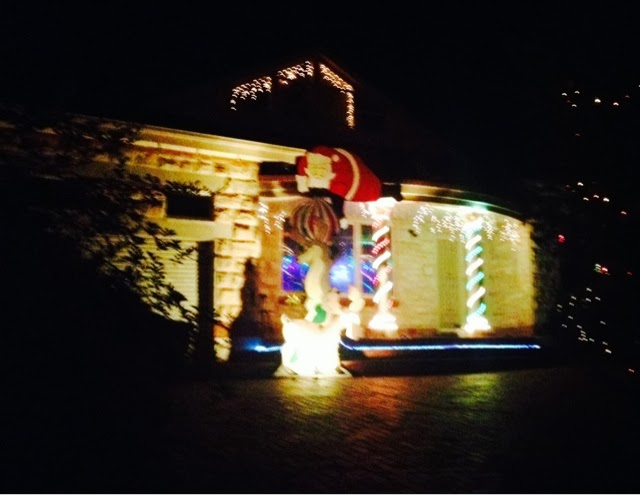
Deep in the Adelaide Hills, South Australia, nestled amongst orchards of fruit trees, is the charming town of  Lobethal. Lobethal in German means the ' Valley of Praise' but at this time of year it becomes the 'Valley of Lights, as the community comes together to celebrate Christmas with an amazing display of festive lights.

Founded by Prussian/German immigrants in 1842, Lobethal was an important local wool processing centre up until the early 1990's and at one stage even had its own cricket bat factory. Lobethal was also one of the South Australian German towns that had recieved a name change during the First World War, temporarily becoming Tweedvale in honour of it's primary industry. However it was in 1952 that the town started to became known for something very different, it's annual Christmas light display. Since that time thousands have flocked to the picturesque township to grab themselves a glittering slice of Christmas and witness the largest community Christmas light display in the Southern Hemisphere.

For the last few years my family and I have made the pilgrimage up to Lobethal to be there when the lights go on. Our yearly ritual is to arrive well before dark and to enjoy tea at one of the local hotels. This year we enjoyed a wonderful meal at The Lobethal Hotel before heading off to the Centenial Hall which hosts the annual Christmas markets. The main street was now beginning to fill up with people from all walks of life from around Adelaide. Makeshift stalls were set up outside house fronts, selling glow sticks and knock off light sabres to passing revellers. As is our custom, we grabbed one for each of our children so they too could become part of the light show. 


Soon we arrived at the classic art deco style Centenial Hall to investigate this years markets. As we browsed through the tables laden with local handy crafts, novelties and confectionary, we chatted to the stall holders, many familiar from previous years. Soon the pocket money was starting to burn a hole in my children's pockets and they were thrilled to find bags of chocolate reindeer poop and reindeer noses (in reality just repackaged choc-malt balls, but who'll let the truth get in the way of a good gimmick). Eventually we made our way past all the jewellery, homemade ties and beautiful country cooking, to find the stairs that led to the jolly old elf himself. However this year as we moved to join the cue, my kids indicated that they were either too cool or too terrified to sit on Santa's knee. After a bit more browsing we moved to the main street to find that the sun is beginning to set and the Christmas lights had started to go on. Buildings, previously unremarkable, suddenly popped out of the street scape, exploding with colour, fake icicles and neon reindeers.
The crowds had continued to increase when we came to the visual highlight of the evening, the fireworks display. With a take away coffee  and glow sticks in hand, we headed for our usual spot beneath the pine trees that lined the edge of the oval. With the sun finally setting, we began to get a full view of the Christmas lights in the streets nearby, and very soon the ones that started to explode through the night sky in a rainbow of colours. 
 
If the fireworks were the visual highlight, then the Living Nativity Scene, complete with donkeys, camels and sheep, was the spiritual centre piece of the proceedings. All ways with standing room only, this annual presentation by the local Lutheran Church commmunity capped off the evenings proceedings. With this pride of place, the Nativity Scene demonstrated that the Lobethal Lights is not just about Father Christmas and faux snow in the summer heat. It is primarily the celebration of the birth of the King of Kings, the man who sought to reconcile humanity to God and to one another. This is what I love about the Lobethal lights. Rather than a commercial venture designed to part us from our hard earned dollars, here we have a community that comes together to present the wider populous with a unique Christmas Gift. It is a present that combines both the cultural festivities and trimmings of the Christmas season with its true spiritual core, the birth of Jesus of Nazareth. Long may the Lobethal light up at Christmas.