Thursday, 29 June 2023

The Prodigal Statue


Front cover of a photo novel with Denny Miller as Tarzan standing in front of the statue.

The Beginning
In 1981, I picked up a comic from my local news agency. As a nine-year-old with a love of the fantastic, I grabbed a comic entitled Hellfire, which featured a horned monster on its cover terrorizing a young couple. It was a striking cover that captured my imagination. I enjoyed reading it (mainly stories about the DC horror superhero, The Demon), but it was the image on the cover that has stayed with me through the years and started me on a strange journey of discovery. 

 Hellfire (1981). This one-shot horror comic was published in Australia by Murray Publishing.

The picture was by Spanish artist, Josep Marti Ripoll, under the name, Marti Ripoll. It was originally featured on the front cover of Professor Zamorra #85: Der Feuergötze, a 1977 German novella by Von Robert Lamont, published by Bastei Verlag. The title translated into English is The Fire Idol.


Tarzan the Ape Man (1959)
 
 
It was a year or two later that I first saw the film Tarzan the Ape Man (1959), starring Denny Miller as Tarzan. It's at the film's climax when Tarzan is saving Jane, her Father, and his partner Holt from a fiery sacrificial death, that a large statue of a horned humanoid monster holding a snake is featured. As the film finished I raced to my comic box, feeling I had seen the horned statue before. As I flicked through the stack, I finally came to Hellfire and realized that I had a match. The idol, on whose sacrificial altar the wild inhabitants of the lost city tried to present Jane as a burnt offering, was the same as the one on the cover.


Holt (Cesare Danova) and Jane (Joanna Barnes) climb the statue to escape the fiery sacrificial pyre in Tarzan the Ape Man (1959)

I thought that this would be the end of the appearance of the mysterious statue, however sometime later I sat down on another Saturday morning to watch another epic fantasy movie, director George Pal's Atlantis: the Lost Continent. It was as the characters were entering the temple of Atlantis that something caught my eye, there sitting in the middle of the temple was a familiar statue, the horned man-beast from my comic and from the lost city high atop Tarzan's Mutia Escarpment. However here the head of the snake had been removed and replaced with a dome-like structure. And it appears that another coat of paint had been applied to give it a different look from its previous appearances.

Azor the High Priest (Edward Platt) and Demetrios (Sal Ponti) look upon the statue, minus the snakes head and mace, in Atlantis, The Lost Continent (1961)

Until recently the statue had become just a faded memory from my childhood until I was discussing  Denny Miller's Tarzan the Ape Man with fellow fans on FaceBook. It was now that I realized that I may be able to solve the mystery of the amazing horned idol. After some discussion with my fellow fans, I discovered that the statue originally appeared in the 1955 movie, The Prodigal, starring Lana Turner and Edmund Purdom and Directed by Richard Thorpe (Tarzan Escapes (1936), Tarzan Finds a Son (1939), Tarzan's Secret Treasure (1941) Tarzan's New York Adventure (1942). The art direction for this film was overseen by Cedric Gibbons and Randall Duell and it is they that were probably responsible for the amazing statue. It is interesting to note that the set decoration was the responsibility of Edwin B Willis and Henry Grace, the latter of which was also the Set Decorator on the other two MGM movies, Tarzan the Ape Man and Atlantis, The Lost Continent.

Where it all began, Samarra (Lana Turner) and the statue in The Prodigal (1955).

In the end, it seems that Henry Grace was the common denominator in utilising this stunning 11-foot tall and 3000-pound, fibreglass statue (www.volusiariders.com/49-stories-road/204926-babylonian-fertility-god-demon.html) in the three movies produced by MGM and thus increasing the cinematic presence of this amazing product of the art department.

Worship in the Temple of Astarte in The Prodigal (1955).
The Statues Identity
In The Prodigal, the statue is seen in the Temple of Astarte and is the male counterpart of the goddess, the storm and fertility god, Baal (Lord) Hadad. He, and the many versions of the storm god throughout the ancient near east (ie, Marduk, Teshub, Enlil, etc) were usually portrayed as having the horns of a bull and sometimes the body of a bull and at other times, riding a bull. He is often depicted holding a club or mace, as in the above picture, as well as a hand full of thunderbolts.

Depictions of the storm god with the horns of a bull and wielding an axe or mace
in his right hand as the movie statue is. The figure on the left, instead of
holding thunderbolts is holding a snake as the movie statue is.
There is also the accompanying legend of the storm God fighting and defeating the great dragon or serpent of chaos that symbolises the sea, an action that resulted in the appearance of land out of the primordial ocean. In the minds of the ancients, this battle was re-enacted time and time again, when people on the land witnessed the storm raging over the sea, thunderbolts being hurled down from the heavens into the raging waters. In the movie statue being discussed, it is possible this defeated serpent of chaos that can be seen in the hands of the storm god. Another possibility is that it is the 'Serpent of Splendour' or the Mushussu, often depicted in many Babylonian pictures of the storm god Bel (Lord) Marduk.
Bel Marduk and his Mushussu (The Serpent of Splendour).

Depictions of the storm god from various ancient near eastern cultures,
each featuring the bull motif either as a physical feature or chariot/throne.
Many of these themes can also be found in the Hebrew Bible and explain the association of the golden calf (although discouraged) with the worship of the Israelite god Yahweh (Deuteronomy 9: 16, 1 Kings 12: 25-30).

Moses smashed the tablets of the Ten Commandments in protest against the Israelites depicting Yahweh as a golden calf.
At various points he is also depicted as a storm god, slayer of the dragon, and the one who divides the seas to bring forth land (eg. Job 26: 1-14), themes that are also found in the New Testament (Mark 4: 35-40, Revelations 12). As can be seen, the power of this mythology and imagery is very strong and continued to persist, entering classical mythology (Zeus transforming into a bull) and even Norse mythology (Thor's wielding of a hammer and battle with the serpent Jormungandr).
Clockwise from left to right: DC comics character Baal-Hadad, the movie statue's head, and another picture found on the internet depicting the god Dagon but seemingly inspired by the movie statue.

Where is he now?
After some time surfing the internet and responding to comments on an earlier version of this article, I managed to piece together some of the statue's journey after its movie career ended. 

In 1970, MGM auctioned off thousands of props and costumes. Along with Dorothy's ruby slippers and George Pal's time machine, the statue and a smaller version of it (seen below) were sold (https://youtu.be/1wReBwaorjc).


During the 1970's it ended up in a secondhand/junk shop, in Ogletown, Delaware, for several years (
www.tsutpen.blogspot.com.au/2012/01/before-and-after-250-babylonian.html?m=1). It was around this time in 1977, that the statue was used as the inspiration for the cover of Der Feuergötze. Eventually, the statue was sold to a travel agency, Tranquillity Travel, in Dover, Delaware, where it sat out the front of the business on Route 13 (www.tsutpen.blogspot.com.au/2012/01/before-and-after-250-babylonian.html?m=1). It was here that the statue got its next big modelling gig, appearing on the cover of the Live Skull album, Snuffer, released in 1988.
In 2003/2004 the statue was bought by Denney Van Istendal for $5000 in Lumberton, New Jersey, much to the horror of the local community (www.roadsideamerica.com/news/10348). Eventually, after much controversy, the statue was put up for sale again in 2009. For some time the rumour was put forward that it had been sold to a bar in Philadelphia (www.roadsideamerica.com/tip/1615). However, the truth is that it was purchased by someone nearby and still resides in Lumberton. With this news, many questions still remain:  Will the statue ever be placed in a museum somewhere and restored to its cinematic glory?  Will it ever be reunited with a new snake head and mace? Where is the smaller version of the statue?  And finally, will it ever make a cinematic comeback?
The statue in Lumberton, New Jersey
The statue with the 'For Sale' sign.
 

Sunday, 1 March 2015

Q Castle in the 21st Century

In 1999 Quentin Castle left his home town of Adelaide to follow his calling as an officer of the Salvation Army. When he returned to Adelaide  a decade later, he awoke to discover that it was the 21st Century.  He now wanders the streets of the future, a  man out of time facing the challenges of the world of tomorrow. These are his adventures........

This was how I felt recently when I made one of my few trips to the city center since returning to Adelaide several years ago. There was a time when I would be in town at least six days a week. Everyday I would pass through town and spend my time browsing in shops between connecting buses. Whether it was during my university days or my teaching career, the streets of Adelaide were my playground, the comic shops and record stores my regular haunts. I had even gotten to know Toys'r'us so well, that when people mistook me in my 'teachery' clothes for a shop assistant, I could direct them to the right isle. 'Pink Power Rangers are in number 3' or ' Biker Mice from Mars toys in 8', I would reply, the town was mine and I knew it backwards. I even had a regular beat that I would walk from King William St to Pultney St, scouring every model shop and book exchange for all manner of sci-fi and pop culture esoterica. I knew the names and faces of shop owners and they new me as a regular. I even had my favourite food outlets that I would frequent. I was the mighty hunter and the arcades of Adelaide were my jungle.

Christmas was always especially wonderful in Adelaide. The giant Santa, aloft the John Martin's building, looked over Rundle Mall like a mighty colossus. It was the pinnacle of the wonders on display in the store fronts of department stores, wonders that  made the city a place to soak in the magic of the season. This was the Adelaide of my youth.

Recently, after being away for so many years, I returned to my beloved home town. No longer do I need to travel through town to catch buses, so visits to the city are far and few between. I had heard recently that the giant Santa was nowhere to be seen at Christmas. I was told that there was a rather under whelming seasonal display presented in the city but I still held out hope for the beloved town of my memories. This hope began to dwindle as I existed a city park house and walked out into Rundle mall for the first time in years. As a child I loved the story of Buck Rogers, an adventurer who  finds that he has slept for 500 years, waking up in the 25th century. Sadly on this trip, this was exactly how I felt. As I exited the lifts of the park house I was struck by the simultaneous familiarity and strangeness of the environment.  There was architecture and fixings that told me I was home but beloved shops and entrances were now gone, replaced by different business's with there own additions to the premises. I stood in an arcade and stared at a doorway that used to be a glass wall, my favourite comic shop was gone. There was also once a  record shop nearby, but the one I came across  wasn't it. Time had moved on, things had changed, the colourful characters that once inhabited them, gone. I had woken up in a future world that had moved on while I had slept.

After I had attended to my business, I went for a walk to find an ATM attached to my regular bank. I was soon frustrated that  I couldn't find one, I used to know where they all were but it had been such a  long time between shopping trips. I decided to ask at an information booth that I knew was at the other end of the mall, only to find that it no longer existed, probably ten years gone. As I continued to seek help, I headed for the one place I knew I would see something familiar, a comic shop. It wasn't the comic shop of my youth but I knew that it would be full of things I found comforting, and I was right. With in moments I was in Pulp Fiction Comics, drooling over the merchandise and listening to some cool music. As I perused the titles on the  shelves, I reflected on my visit and decided that although much had changed, Adelaide was still a great town. The big Santa may have gone but the Malls Balls were still there. My favourite joke shop may have closed but the moon still hung in its orbit. My regular comic shop may be long gone but there were new ones..... and the apes hadn't taken over in my absence.


After obtaining some local knowledge in the comic shop, I headed back down  Rundle Mall to the appropriate ATM, which I suddenly remembered, was where it had always been. Some things change, somethings we forget, but this isn't a bad thing. If things never change, if we never change, we stagnate and die. Adelaide's not dead, it's a wonderful town with a wonderful future full of new wonders and magic.

BTW, if you find yourself in Pulp Fiction Comics, ask for a copy of Anthony Castle and Chadwick Ashby's graphic novel DEAD ENDS: Fables of Loss and Morality. It's a great read by two great Adelaide talents (i'm not bias at all).

Friday, 26 December 2014

The Policeman's Special or Half'n'half: My Festive Drink


It's Boxing Day and there's a drink I have every year that is special, different and sums up the festive season for me. It is the old Half 'n' half, otherwise known as the Policeman's Special, the drink of champions. I was first introduced to the Police Man's special as a child, gained a taste for it and loved it ever since. It's origins for me are lost in the mists of time, but I can tell you where I came across it. In the east end of Rundle St, Adelaide, South Australia, there was an old grocers shop, Randall's Fruit and Veg (or Frut and Veg according to the dilapidated sign out the front). Run by Mr Randall, it sold all kinds of things from basic convenience items to sweets and a whole range of things in between. One of the most popular features of Mr Randall's shop was his ginger beer on tap that saw a range of city dwellers, from police officers to Hare Krishna's, frequenting the place for a draft of this wondrous drop. It was in the mid-seventies that my family moved church congregations from the Salvation Army Unley to the Salvation Army Adelaide Congress Hall which was located in the east end of the city square mile. Not far from the Adelaide Citadel was Mr Randall's shop and the informal initiation into the the Adelaide Congress Hall Salvation Army Band was to drink a pint of the mystical Half'n'half. A yard glass was even available for the more daring who thought they were man enough ( no women in the band then) to take on challenge. Although my father found the drink repulsive, it became a firm favourite of my brother and I.  Every Friday night, following the young people's band and choir practice at the Salvation Army citadel, our father would take us to Mr Randall's shop to get a pint of Half'n'half and a strap of the usually stale and tough licorice which was just gold. To us this was heaven and almost worth missing out on The Incredible Hulk TV show each week in the days before VCRs. We would climb upon the ancient counter stools fixed to the wooden floor and drink our pint of Half'n'half. We would then walk back to the car, eat our licorice strap and dream of the wondrous Saturday morning cartoons waiting for us on the other side of sleep.

By the mid 1980's Mr Randall's shop had gone. Mr Randall had retired and the shop that replaced it, which also sold Half'n'half, didn't stand the test of time. We too had moved on to comics and milkshakes, bought each Friday night from a deli/milk bar nearer to home, but the dream lived on. Each year at this time, when we don the gay apparel and troll the yuletide carol, I drink a glass of Half'n'half in memory of Mr Randall and the old days of the 'Frut and Veg shop'. Why this time of year you may ask? Because all the ingredients are here, bought for Christmas day lunch and ready for the mixing. And what is this mystical recipe you may ask? Well I've included it here for the curious and daring.


Recipe
1/2 a pint of milk
1/2 a pint of ginger beer

Method
1) Pour the milk into a glass. 
2)  Add the ginger beer.
3) Wait till a curdled head begins to form and drink.

And so there you have it. I hope you enjoy a pint or two of Half'n'half and that God brings you lots of hope, peace, joy, love and Santa this Christmas and New Year.


Wednesday, 17 December 2014

Jesus And The Rings Of The Phantom.

The Rings of the Phantom, the Skull Ring and the Good Mark Ring

One of the greatest masked superheroes of the modern age is the Phantom, the Ghost Who Walks, friend of the Pygmy Bandar and the Guardian of the Eastern Dark. Older than Batman and Superman, he has graced page and screen for nearly 80 years. One of the strengths of the character is the faux mythology that has been built around the character that links him into myth, legend and history of the real world. Whether it be Arthurian, Greek or Roman legends, this scourge of piracy has a connection to it all. 

While browsing through that font of all wisdom, Wikipedia, I discovered that when it comes to Christian history and theology, this is no less the case.  The most direct link in Phantom law to the the Christian faith are the two rings he uses in his battle against evil. The first ring we will focus on is the Good Mark Ring. Many do not realize the significance of the symbol on the ring and the depth of meaning behind it. It has been described as the crossing of two sabers however the design has an ancient origin, The symbol's origin is Greek and was traditionally known as the Chi-Rho. It was used by ancient Greek scholars to mark valuable or noteworthy passages in the margins of a text. It combined the two letters X (Chi) and P (Rho), the first two letters of the Greek word 'chreston' which meant 'good'. It was literally the 'good mark'. The Chi- Rho eventually went on to be used by the early Christians as a symbol of Christ. The original Greek form of Christ, 'Christos', also began with XP. This, coupled with the cross shape recalling the crucifixion, made it ideal for use by the early Christians.  This use as a symbol for Christ can still be seen in the word 'Xmas', the common abbreviation of Christmas. It was the Chi-Rho symbol that the Emperor Constantine reported seeing  in his vision that led him to accept the Christian faith as the official religion of the Roman Empire. Through the years, the Chi-Rho was adapted into many stylistic designs by the church and became one common version of the Christian Cross motif. It is of no coincidence then that when the Phantom was looking for a symbol to represent his protection, he literally chose to use the 'good mark'. Either that or Lee Falk and Co. did their research well.
Three variations of the Chi-Rho symbol. The Phantom's Good Mark fits well as another variation.
The origin of the Skull Ring has an even closer affiliation with the Christian faith, that of Christ himself. The mythology, as set up in the unfolding narrative of the comics, is that the Skull Ring was presented to the original Phantom by the great physician, scientist, and occultist, Paracelsus. It was fashioned from the nails that held Jesus on the cross and was originally owned by Emperor Nero, who had led one of the early Roman persecutions of Christians. This reappropriation of crucifixion nails for other purposes was not unheard of. The nails used in crucifixion were iron spikes between 5-7 inches long and were often collected and highly prized  as healing amulets. Like the legendary Holy Grail  that was pressed into the service of King Arthur, the Skull Ring is a relic of Christ that continues to be used in the cause justice and redemption of a fallen world, or so the ongoing chronicles of the 'Ghost Who Walks' tell us.


Wednesday, 3 December 2014

Advent Begins: May the Darkness Flee.

Today (sunday 30th November) was the start of Advent, a time of the year I always love. With the placing of wreaths, the lighting of candles and the decking of halls with Christmas decorations, it sounds cliche, but there is a magic in the air. As we turn on the festive lights and get to see the amazing creations our neighbours have put together, the suburbs begin to change. For me these days it begins around Halloween when, on the 29th of October, the neighbourhood is beginning to open up. Rightly or wrongly, this transplanted celebration is gaining popularity amongst the kid’s of Australia. Instead of the legion of the brave heading out to face off the forces of evil in fancy dress at the time when the nights are getting longer and colder, our kids hit the streets looking for lollies when the days are getting longer and warmer. Before the fairy lights lace the verandas, the pumpkins have appeared on the letter boxes, letting the trick or treaters know that it’s safe to knock on the corresponding door. It is now that I see children at my door, dressed in an array of amazing costumes, who are usually hidden with in their own homes, stuck behind computer screens and retreated from the streets around them. The darkness is beginning to subside, the light is coming. With in days Christmas pageants are taking place and Santa has come to town. Carols are beginning to be heard in the stores and the family tree trimming takes place. And then comes today when the first candle of Advent gets lit, the candle of Hope.

Jesus Looks Ahead
In worship today the set gospel reading was taken from Mark 13. On first glance it is an account of Jesus giving his disciples information about the future. It describes tribulations that are yet to come, the destruction of the Jerusalem Temple, natural disasters and cosmic phenomena marking the end of history and a warning to be ready for Christ's  return. At first glance it is hard to see how this relates to Advent, the weekly count down to Christmas. But on reflection it's makes perfect sense. Many of the scenarios described were already happening at the time of Christ and even at the time of the writing of the Gospel of Mark several decades later. In fact some of Jesus' predictions didn't come to pass until 70 AD when the Romans finally destroyed the Temple in Jerusalem, the place where creation and creator were connected in ancient Jewish belief. The might of Rome crushed the intimate bond between God and his world, seemingly never to be rebuilt again. However God had a plan that would out run the banners of Rome. In the person  of Jesus, God established a new intimate connection with humanity. However when Rome tore him down, God raised him back to life. In Christ there is hope that calls all of us to put our trust in him and the way he calls us to follow. When the sky is falling, and the sun refuses to shine, because Christ lives with in us, there is hope

The Candle of Hope
The Candle of Hope reminds us that no matter how dark our world gets, there is hope. That when our relationships are messy and love has seemingly died, there is hope. That when our bodies give up and our mind fades, there is hope. When there seems to be no light at the end of the tunnel, and the end is nigh, there is hope. May the light of hope burn brightly in your advent season this year.

Wednesday, 22 October 2014

Rejoice; My Favourite Worship Song

This is an article I wrote recently for our Salvation Army publication, On Fire. It appeared in this years July 12 issue.

It was when I was at university in the early 90’s that I first came across the song Rejoice, written in 1983 by British songwriter Graham Kendrick. I loved the combination of a driving melody coupled with words that were effectively a call to Christian action. As a Salvationist, the military imagery in the chorus and verse 1 was also a winner for me personally, as I related to the image of the church as an army taking up spiritual weapons. In the twenty years or so since first hearing it, I’ve had the opportunity to introduce the song to various groups of people through my ministry. I’ve even based a series of sermons on the various verses, high lighting the spiritual encouragement with in it.

My favourite parts of the song are the chorus and the second verse. The chorus call us to celebrate the fact that we have Christ living within us. 

Rejoice! Rejoice! Christ is in you
The hope of glory In our hearts
He lives! He lives! His breath is in you
Arise a mighty army We arise

It reflects on the miracle of God’s presence through his ‘breath’ or his ‘holy spirit’. As a consequence of this we have a bright future as part of God’s eternal kingdom and a part to play in the redemption of the world. This truth must be something that causes us to rejoice and something that mobilises us to carry out God’s purposes in the world around us.


Vs 2
God is at work in us His purpose to perform
Building a kingdom of power not of words
Where things impossible by faith shall be made possible
Let's give the glory To Him now.

The second verse drives home the point that God dwells in us in order for us to work with him. The work he has for us is something that is active, miraculous and not merely theoretical. It talks about ‘building a kingdom of power not of words’. As his ‘army’ we are seeking to bring others to Christ and to put his law of love and justice into action in our sphere of influence. Following Christ is not a passive past time but a dynamic lifestyle that calls us to impact the world around us. The song urges us to ‘rejoice’ at the knowledge that we are an empowered, transformed people, equipped by God to carry out his purposes.

Monday, 13 October 2014

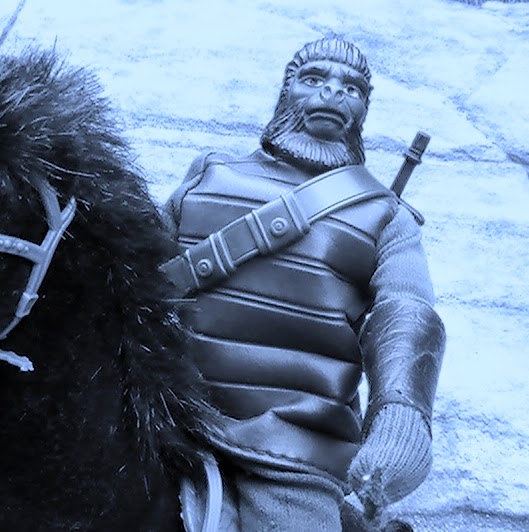
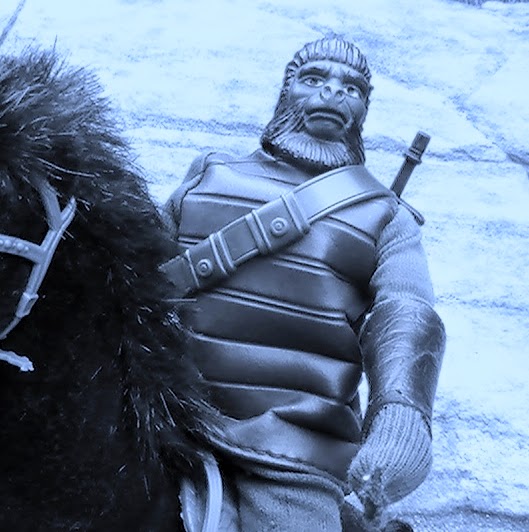
The Ape General


Through the various versions of the Planet of the Apes (POTA), the figure of the Ape General is a reoccurring archetype. Although a central figure in many of the various version and sequels, the figure of the Ape General is no where to be found in the original novel, Planete De Singe (1963) by Pierre Boulle.  In the original novel, the main gorillas of note were Zoram and Zanam.  These two kindly lab assistance treat the books hero, Ulysse Merou, well while he is in captivity after landing on the distant planet Soror with his fellow space faring Frenchmen. In the film version of the novel, Planet of the Apes (1968), these two characters are replaced by a single gorilla called Julius, who takes great joy in tormenting the astronaut Taylor when Zira, the chimpanzee psychologist, is absent. Although there are various gorilla soldiers, a military leader is no where to be seen.

Ironically, although never appearing in the original novel, the figure of the Ape General was actually first created by Boulle in The Planet of the Men (1969), a proposed script he wrote for the second ape film. In his script he created the character Field Marshall Urus, a bumbling gorilla who fumbles an attack on Taylor and his humans which alters the fate of ape and human kind. Urus is a military incompetent who charges the human forces in broad daylight with no real strategy and finds his army out maneuvered and routed. It is this that leads to the final downfall of ape civilization.

When the final film version, Beneath the Planet of the Apes (1970) appeared several rewrites later, Field Marshall Urus emerged as the war monger General Ursus, the leader of the ape military who leads the gorilla army into the nuclear wasteland of the Forbidden Zone. Not as buffoonish as Field Marshall Urus, Ursus is a more serious character who believes that there is a threat dwelling in the Forbidden Zone that needs to be eradicated if Apedom is to reclaim the area for itself. Soon they stage an invasion of the Forbidden Zone and find themselves face to face with a race of mutant humans who still live in the ruins of New York. Unfortunately they possess a global killing nuclear missile that, during the slaughter of the pacifist mutants, is activated by the fugitive astronaut Colonel George Taylor. Suffice to say the earth doesn't survive. In many ways Ursus is the figure of the crazy general, the one who insanely only sees military solutions to problems and will happily start a war that will end with disastrous results.

The Battle for Earth's Future
The next appearance of the Ape General is in Battle for the Planet of the Apes (1973). He appears here in the form of General Aldo (Claude Atkins), an ape still bitter about the treatment of his kind before the revolution and who longs to see all humans in servitude or dead. This is at odds with the vision of the revolutions leader, Caesar (Roddy McDowell), who sees a positive place for humanity in the new social order.  Not surprisingly, Aldo is the Brutus to Caesar’s Caesar, the traitor who desires to over throw the king to create a different path for ape society. This new path would be one human free and naturally guided by him and his gorilla army. Fortunately for ape society, this potential usurper is finally revealed and dispatched by Caesar during one final confrontation leaving the future in more benevolent hands.

The General Comes to TV
After the movie series finished, the POTA  franchise moved to the small screen. It was here that the figure of the Ape General took on its most well known form, that of General Urko. On the face of it, the name Urko seems to be an amalgamation of the names Ursus and Aldo. It is as though he was intended as a composite character that would be reminiscent of the two general figures from the cinematic cycle. It appears that in early draft versions of the series the character was called Ursus and eventually altered to Urso. When actor Mark Lenard tried to pronounce his characters name through his ape make up, he found that he had difficulty in pronouncing it, the resulting word sounding more like a term of abuse that the name of an ape general. And so the name became General Urko and would become a character that received more screen time than Ursus and Aldo combined.

Set in the year 3085, over 800 years before the original film, the TV show tells the story of two astronauts who have found themselves lost in the future and being hunted down by the orang-utan politician Councillor Zaius and his chief of security, General Urko. The role of Urko in this series is different from that of previous ape generals. If the astronauts, Burke and Virdon are the archetypal noble outlaws, then Urko is the hard nosed sheriff who doggedly hunts them down, while they travel about making the world a better place for human and ape alike.  He is a character who is able to have ongoing adventures and character development in the Planet of the Apes scenario, not one that must face death at the stories conclusion. We get to see Urko in a range of situations. We find out that his wife’s name is Elta (The Trap), we watch him have to work together with a fugitive astronaut (The Trap), and we see him try and fix a horse race (The Horse Race). Followers of the POTA series were able to form a stronger attachment to the character and because of this he has come to be the most well known of the Ape General figures. A good example of this is the fact that he often appears alongside exclusively POTA movie characters in POTA action figure sets.

The General Gets Animated
This popularity was also strengthened when another version of General Urko (Henri Corden) appeared in the animated series, Return to the Planet of the Apes (1975). What is interesting about this incarnation is that it incorporates many elements of previous Ape Generals in the one character. Set in an alternate version of the original POTA story, Urko works along side Doctor Zaius in the 38th century, as Ursus did in Beneath. Like Ursus, he stages various military incursions into the Forbidden Zone as he seeks to eradicate the human/mutant threat. Like the original Urko, this version is continually hunting for the fugitive astronauts and like Aldo, he longs to usurp the government and seize power for himself. This scheming eventually leads to him being suspended from duty for three months for fraudulent activity. During this time he is replaced by another gorilla, Colonel Rotok, who is actually secretly taking orders from Urko. It’s at this point in the franchise that the figure of the Ape General has fully crystallised. Now all the facets of previous versions find a place with in the one character. However this would be the last Gorilla incarnation of the Ape General on screen. In POTA comics, other incarnations would appear, such as General Ollo, General Ignatius, General Gorodon and Peace Officer Brutus. However on screen the future of the Ape General lay in the hands of another simian species.

Rise of the Chimps
In the years between POTA movies, the gorilla had lost its position as the killer ape to its African cousin, the chimpanzee. Genetically closer to humans, the chimpanzee is known to hunt small animals for food and murderously go to war against rival tribes over territory. In many ways they are the most like us of all the great apes and this realization has caused the role of the Ape General to be recast. In 2001 Tim Burton directed Planet of the Apes, a re-imaging of the original story that mixed elements from both the book and the original movie with new characters and scenarios. In this film gorilla soldiers, such as Colonel Attar (Michael Clarke Duncan), are subservient to the chimpanzee General Thade (Tim Roth). The story revolves around an astronaut, Leo Davidson (Mark Wahlberg), who leaves the space station Oberon in the year 2029 to search for a lost research chimp. The chimp, Pericles, was sent out in a space pod to investigate a nearby electro-magnetic space storm and never returned. While searching for the chimp, Leo enters the storm and finds himself sent forward in time to the year 5021 crashing on an alien planet. While on the planet he finds that it’s occupied by apes and humans, the later existing as a slave class and treated like animals. Soon Leo is introduced with General Thade, a murderous chimpanzee descended from the ape messiah Semos with a vicious hatred of humans. Thade knows from family tradition that once humans ruled over the apes and that as long as they existed they would be a threat. Little does he realise that he, and all others on the planet, were actually descendants of the apes and crew of the Oberon that had passed through the same space/time storm that Leo had passed through. Due to a strange time dilation effect, the space station had crashed many centuries before, it’s survivors populating the planet before Leo's arrival.

Despite being a chimp, Thade is in some ways similar to the General Urko character of the cartoon series. He chases political power and seeks to see the subjugation or destruction of all things human. He understands that humans pose a real threat to ape domination and he will go to lethal lengths, even against fellow apes, to make sure their legacy stays intact. Unlike previous Ape Generals, Thade also wants to assert his sexual dominance and claim Ari, the main female chimp, as his mate. Ari is a human sympathizer and seemingly infatuated with the very human Leo. This love of his most hated species seems to fire Thade's lust to posses Ari, who makes a very public display of rejecting his advances. When Ari escapes with Leo and a band of humans into the Forbidden Zone, Thade announces that she has been kidnapped and uses it as an excuse to declare marshal law. The final outcome of this movie sees Leo escaping in Pericles' space pod back to earth, only to find that Thade had preceded him, seemingly having escaped to Earth in Leo's original craft, passing through the same space/time storm. The final scene shows a newly landed Leo standing in front of the Lincoln Memorial, now wearing the face of General Thade and surrounded by ape police. 

The General Breaks the Glass Ceiling
One lone female version of the Ape General is found in the Dark Horses comics series, The Planet of the Apes: Human War (2001). Although not technically a general, this story features, Minister Shiva, a chimpanzee descendant of General Thade. The armour wearing Shiva carries the same narrative function as her anti-human military predecessors. In the years following the human revolution lead by Leo Davidson, Minister Shiva and her army continue the fight against the remnants of the up rising, seeking the near extinction of humanity and supreme political power. Despite the change of species and gender, the characteristics of the Ape General character type cease to change.

The New Series
To date, the new POTA movies haven't featured an Ape General. Rise of the Planet of the Apes (2011) and Dawn of the Planet of the Apes (2014) do feature Koba, a bonobo, who functions as Caesar's right hand ape. In many ways he is a Brutus, a re-imagining of the Aldo figure from the original series. Despite not having a rank, Koba has a similar function to Ape Generals in other movies. He is the human hating zealot who seeks to over throw the more moderate leadership of the status quo in order to institute a policy of human enslavement or extermination.


Through out much of the POTA saga, the figure of the Ape General has been present. They represents the desire for military might and xenophobia to over throw moderate government and institute marshal law. They are the symbol of armed opposition to human liberation and of ape supremacy. As with many character types in the POTA series, they are a reflection of some of the darker elements of human kind, showing us ourselves through a simian reflection.


Thursday, 11 September 2014

Braving the Gravitron

The Horror Hotel at this years Royal Adelaide Show.
Today I found myself spinning at 170km, stuck to a wall in side a large saucer shaped object. No it's not an alien abduction but a trip to Adelaide's annual Royal Show. The Australian equivalent of a state fair, the Show has personally been  a great source of fun and excitement, forming some of my earliest and fondest childhood memories. The Adelaide Royal Show began in 1840 and today continues to be a great mix of sideshows, junk food, produce and animals. As a child I remember spending what seemed like hours walking through the stock pavilions with Mum and Dad, hoping that we'd soon leave to find the showbag hall. Often things would go from bad to worse when my parents would stop to talk to friends and acquaintances they'd stumble across, making the anticipation so much greater. When we eventually got to the showbag pavilion it was like heaven. 

Looking back there were several showbags that I remember fondly. I remember in about 1978 getting the Space War showbag full of faux Star Wars novelties. There was the inflatable 'laser sword', the jigsaw puzzle of Star Wars-esque space craft, a Space Wars badge, a Darth Vader-ish mask and black plastic cape. I remember many a fun time being the 'Dark Lord of the Sith' in the remaing days of the September holidays. Another winner was The Incredible Hulk showbag, which amongst other things, included a plastic mask, poster and parachute Hulk. I remember coming home that night and watching the Hulk on TV while playing with my Hulk toys. I could never work out why Ol' Jade Jaws needed a parachute but it was cool none the less. 

It was in 1982 that I remember another fond showbag memory. This particular year they brought out a Doctor Who showbag. It came with a jigsaw puzzle, a badge, invisible ink, a cardboard T.A.R.D.I.S. model and a board game. Coming in at a dollar it was a cheap bag for the time and a gold mine for a merchandise starved Doctor Who fan. What was confusing though was that all the artwork reflected Doctor Who as it was in 1975, made all the more anachronistic in that the Doctor was now played by someone else. I later discovered that the board game had been part of a Weetabix cereal promotion in the UK in 1977 and that the showbag had originally appeared in Australian shows in 1978. Maybe the showbag people were cracking open the old stock. I didn't care, I had a Doctor Who showbag filled with images of my earliest memories of the show.
A wonderful view from the Ferris Wheel.

As I spun around like fruit in a blender, I reflected back on the series of events that had lead me to this moment. I remember walking through the gates with my family and looking down sideshow alley. There spinning in the distance was the Gravitron, that crown prince of fun fair flying sauces. As I gazed at its hypnotic motion, my sons said, 'We want to go on that, but only if Dad does'. After some initial protestations, I knew I needed to man up and take these boys into that swirling world that gravity forgot. Before I could change my mind, I walked up the gang plank of this pseudo-UFO and took my position against the wall inside. Within minutes I was plastered flat to the bulkheads as the machine began to spin. Feeling game, I started defying gravity, climbing backward, Spiderman-like, up the wall. Soon I was half way up, stuck like a fly on a windscreen but loving every minute of it. There I was with my boys, feeling like I was sixteen again, surprised that my coffee was staying down and having the crazy kind of fun only a sideshow, or NASA , can provide. As the ride finished, I staggered out, feeling like I'd been through the spin cycle of a giant washing machine and having loved every minute of it.

As the day went on, I continued to enjoy the time with my wife and children. We watched sheep dog demonstrations, dressage, patted farm animals, played games for soft toys and laughed at each other while we rode a variety of crazy amusements. I continued my fascination with the aesthetics of Ghost Trains, taking copious photos of the facades, but not daring to enter (no one else will go with me). Although the new ones looked cool, I missed the mechanical gorilla holding a severed head that stood on top of the old one (you can never beat the classics). 
The gruesome master of ceremonies on the Hollywood Horror ride.

We ended the day with a ride on the ferris wheel which provided us with a great view of the whole showground.  As I looked at our pile of lolly and novelty filled showbags and the tired faces, I knew that the excitement and the fun of the day would only be over-shadowed by the sugar rush they'd feel when they started to eat the contents of their showbags. As I lent back and looked over the showgrounds, I felt happy and a little bit excited. Soon I would be home, sitting in front of the TV and exploring the contents of my Comic Collector's Showbag, filled to the brim with Phantom Comics and promising even more hours of excitement. The Royal Show may end but the fun lives on.
Watching the dressage while stopping for lunch.

Saturday, 9 August 2014

Battle for the Planet of the Apes and Dawn of the Planet of the Apes: History Repeating Itself?

Recently the latest instalment of the Planet of the Apes film series was released. Riding high on the success of the previous movie, Dawn of the Planet of the Apes opened to box office success and critical acclaim. Although not an official remake, Dawn shares more than a passing resemblance to the 1973 Apes movie, Battle for the Planet of the Apes. One of the main differences between the two films is their positions within their respective series. Where as Battle was the final film in a successful series that was facing decreasing budgets, Dawn, is the second movie in a rebooted series that is just hitting its straps. The original Apes series grew out of a movie that never intended to have a sequel, let alone four. On the other hand, Dawn is part of a pre-planned narrative cycle that moves towards the original Planet of the Apes concept and story line.

The Story Thus Far
Many people would be unaware that the Planet of the Ape began originally as a French novel, Las Planète de Singes by the author Pierre Boulle. Famous in English speaking countries for his novel and the subsequent film, Bridge over the River Kwai (1954), Boulle wrote Las Planète de Signe, a science fiction satire in 1963. Translated in English a Monkey Planet in 1964, Boulle felt the novel to be one of his minor works and potentially unfilmable. However, Boulle was surprised when in 1968, Las Planète de Singes leaped onto the big screen internationally as the Hollywood block buster Planet of the Apes. Following it’s box office success, Planet of the Apes, spawned four cinematic sequels, two TV series (live action and animated), more books, comics and a whole range of Apes merchandise. However by 1977 the Planet of the Apes franchise had seemed to have run it’s course. With the animated series finished and the last British annual and Marvel Comic being produced, the Apes phenomena was soon lost beneath the Star Wars tsunami that would soon engulf the world. Besides a series of 5 telemovies, edited together from episodes of the live action television show and a Hungarian comic adaption of the original novel, both in 1981, all seemed quiet on the simian front.

However by the late 80’s rumours of a new Apes project began to surface. By 1990 original comics based in the world of the Apes movies began to appear. Eventually a another movie adaption of the original novel appeared in 2001 and the Apes merchandising machine began to roll again. Although successful, 20th Century Fox Studios decided not to follow this movie up with a sequel but to reboot the series altogether. In 2011 Rise of the Planet of the Apes appeared in cinemas. Rise retold the origin story of Planet of the Apes. Instead of having intelligent apes from the future come back to the past to set in motion the ape revolution, Rise presented the origin of Ape civilisation as being the by product of human experimentation on apes in the search of a cure for Alzheimer’s. Drawing some comparisons with Conquest of the Planet of the Apes, the fourth film in the original Apes series, Rise was even more successful than its 2001 predecessor. Very soon a sequel, Dawn of the Planet of the Apes, was in production.

Dawn continued the story set up in Rise. Eschewing some of the Frankenstein themes raised in the first film, this movie explored the ‘fear of the other’ and the selfishness of revenge in the face of acceptance and forgiveness. Taking place ten years after the previous film, we learn that the virus, originally designed to cure Alzheimer’s and had caused the intelligence to grow exponentially in the apes, had gone on to decimate the human population. Many of the humans that were left had then turned on themselves, decreasing the human population even further. Meanwhile the super intelligent apes had continued to breed and advance, unaware that some humans still existed. It is when a group of humans enter into the ape’s forest that things become complicated. Also oblivious to the apes existence, the humans had come hoping to reactive a hydro electric damn to give the ruined San Francisco power once again. Despite the trust that develops between Caesar and several of the humans, war eventually breaks out between apes and humans. The conflict is instigated by the revenge filled bonobo, Koba (Toby Kebell) and the fear driven human leader, Dreyfus (Gary Oldman).

A Comparison of Battle and Dawn
In many ways this film is has much in common with Battle for the Planet of the Apes (1973) the 5th instalment in the original series. Both films serve a similar function in the wider narrative of the Apes saga, both depicting the rise of ape society post apocalypse and the deterioration of human civilisation. In the forefront of both versions of ape society is an ape named Caesar. It is he who has lead the apes to emancipation from their human masters. However, these two versions of Caesar are radically different in origin. The Caesar in Battle is the child of Cornelius and Zira, the two chimpanzees from the original Planet of the Apes who have travelled back in time to escape earth’s destruction 2000 years in the future. The Caesar in Dawn is the child of a regular 21st century ape who has had her DNA genetically altered by being exposed to a virus that stimulates brain development. It is this virus that wipes out most of humanity and accelerates the intelligence of the apes that come in contact with it.

The two stories start with an ape society beginning to codify its morality, embodied in it’ most sacred law ‘Ape shall never kill ape’. It is in keeping this law that the apes believe sets them apart from humans, who have effectively wiped themselves out as a species through nuclear holocaust in Battle and un-elaborated global conflicts, post virus, in Dawn. One major difference between the two films is that Battle presents a fledgling ape society where humans are also present. It appears that various sympathetic humans have joined with the apes only to find themselves as a tolerated underclass struggling to find acceptance amongst the three other primate species. Caesar, although good friends with human adviser, Bruce McDonald (Austin Stoker), still wrestles with the role that humans should play with in his newly formed ape society. It is at this point that McDonald alludes to the fact that the future may rely on a change in ape/human relationships. Before long the two, in the company of an orang-utan scientist, Virgil (Paul Williams) head into the irradiated ruins of the nearby human city to gain access to recordings made by Caesar’s parents after their arrival from the future. McDonald hopes that the recording will alert Caesar to the dangers of ape/human hostilities and that unless otherwise mended, could end in the destruction of the earth in 2955. It is in the ruined city that the group comes into contact with the mutants who still live in the city. The mutants are lead by Kolp (Severn Darden), the former chief government interrogator from the previous film who still wants to see the apes subservient again.

In Dawn, the apes have created a human free community which is thrown into fear when a group of humans arrive looking for a dam control center. Caesar in both films has experienced the positive side of human ape relationship, and despite tensions between the groups, soon begins a friendship with Malcolm, the leader of the human party. Shocked by the arrival of humans after so many years, Caesar and hundreds of apes travel to the human city and declare that they only want peace and demand that they be left alone. Frightened by the ape’s show of force, Dreyfus (Gary Oldman), the human leader begins a stock take of the human armoury in preparation for an ape attack.


At this point in the plots of the both films we have a divergence. In Battle it is ape/human society seeking information about the future that stumbles into the home of the ‘other’. The other in this case is the mutant survivors of the nuclear holocaust that ended 12 years before. In Dawn it is humans in search of their society’s future, through the access to electricity, which brings them into the world of the ‘other’, the fledgling ape society. Both films present that moment well known from history, human history that is, when two vastly different cultures come face to face, each assuming superiority over the other. Despite those with in each culture who seek peace, both societies soon fall into conflict based on fear of the different. What hope does a future of peace between ape and human have when humanity couldn’t event live at peace with itself?

'Every Caesar has their Brutus.'
Both movies depict a Caesar who is wisely attempting to guide his new found society in a direction of pacifism. ‘Ape has never killed ape’ is the basic tenant of this ideology and it is this idea that apes believe separates them from humanity and it’s history of conflict with itself. However in both narratives Caesar faces opposition from a rival ape, a symbolic Brutus, who has a score to settle with humanity to the point where he is prepared to break the most sacred ape law. In Escape to the Planet of the Apes, Cornelius reveals that in ape legend it was an ape named Aldo who was the first to say ‘No’ to his human masters. In Conquest of the Planet of the Apes, we come across an ape named Aldo, a government messenger chimp beaten by police after getting spooked by an anti-ape labour demonstration. It is this incident that causes Caesar to yell out in defense of Aldo, thus arousing suspicion that he may be the child of the talking apes from the future. It is this moment that set in place the events that lead to the ape revolution. In Battle, Aldo, now portrayed as a gorilla general, is the leader of the gorilla army and bitterly resents Caesar’s inclusion of human’s in his new society. He plots to arm his troops, destroy all humans and to overthrow Caesar. Unfortunately Caesar’s son, Cornelius, over hears the plot and is pushed out of a tree and mortally wounded by Aldo. Aldo then raids the ape armoury; rounds up all the humans in the ape village into the coral, just as an army of human mutants begin to attack the ape city. Following the defeat of the mutants, and the slaughter of the survivors by Aldo’s gorillas, Caesar confronts Aldo in relation to the death of his son. This confrontation fittingly ends with Aldo falling to his death from a tree at Caesar’s hand. The question is then asked by Caesar if one murder should be repaid with another. Here Caesar realizes that violence and hatred of ones brother is not just the domain of humanity but of ape as well.


Aldo’s equivalent in Dawn is a badly scarred bonobo named Koba. In Rise, Koba is a lab ape who carries the marks of years of mistreatment across his face and body. Initially loyal to Caesar, he becomes incensed when Caesar befriends the humans who have come searching for the dam. Believing that Caesar loves humans more than apes, he follows the humans back to their city, finds their armoury and raids it. Driven by the need for revenge, Koba shoots Caesar, and convinces the apes that it was perpetrated by humans. Soon Koba is leading the apes, armed with stolen guns, in an attack against the human city. During the battle, Koba demonstrates his willingness to kill any ape who disagrees with him, throwing a chimp, Ash, to his death when he refuses to shoot an unarmed human. This and other actions soon begin to polarise the apes, especially those still loyal to the memory of Caesar, including Caesar’s son, Blue Eyes. Fortunately Caesar is not dead, and after being nursed back to health by Malcolm and his family, is able to regain the leadership of the apes through the help of Blue Eyes. Once again we are presented with a scene where Caesar confronts his rival in a battle to the death. This time, rather than a tree, it is the remains of a multistory building from which Caesar’s rival falls to his death. As Koba looks to Caesar to save him from falling, he appeals for mercy saying, ‘Ape shall never kill ape’, to which Caesar replies, ‘Koba is not Ape’.

The Simian Loss of Innocence
Here we have an interesting contrast in the narratives of the two films. Where as Caesar in Battle recognises that both apes and humans can be guilty of violence and hatred, Caesar in Dawn insinuates that any ape who deviates from the great law, ‘ape shall never kill ape’ is no longer ape and therefore has no place amongst their number.
These divergent outcomes reflect the place these films play in the narrative of the series. Battle is a film that is attempting to wrap the up the Ape series with some kind of conclusion. In the end Caesar chooses to include humanity in his new ape society having seen that evil is no respecter of great ape species. The narrative itself is presented as a flashback sequence, a tale told by the Ape Lawgiver, 600 years after the events of the main story, to an audience of humans and apes living in harmony. It is a film that has taken the story of The Planet of the Apes as its starting point and has attempted to move the narrative to a place which is more optimistic. Despite the final ambiguous, but ominous, image of a weeping statue of Caesar, the suggestion is that things have changed for the better on the planet of the apes and men, at least for the time being. Dawn, on the other hand, is a part of a narrative that is working toward the events of The Planet of the Apes. It ends with Caesar’s sad realisation that further war with the humans is now inevitable. Rather than finding a place for humans with in his ape society, he must continue to protect and strengthen his community so it truly will be a place where ‘ape shall never kill ape’, despite the forces that threaten it from with out.

'Who Knows the Future?'
It will be interesting to see where the creators of Rise and Dawn take the Apes narrative next. The follow up to Battle was a TV series that was set 415 years after the scenes with the Lawgiver, in an a future where once again apes were the dominant species and man was a slave class. It is, however, unclear whether it was set in the the same fictional Apes universe as Battle.  Pictures of a futuristic New York City depicted long after the destruction of civilization as portrayed in the movies makes continuity with the film series difficult. It may have been that the creators of the television series merely wanted to set there story in an Apes world where lost astronauts could face the latest ape villain of the week with out worrying about tangled time lines and changed destinies. For all intense and purposes the original Caesar narrative has come to it conclusion at the very same point that the new Caesar narrative is beginning to take off. Dawn may easily be construed as a remake of Battle but the next installment will be breaking new ground in the ongoing story of the Planet of the Apes, as it heads to the point where the original series began. This also something that effects the overall tone of the movies. If the future at the end of Battle is an open book, the future in Dawn is preordained and pessimistic. Dawn's narrative is working its way towards that moment when Colonel George Taylor collapses before the half buried Statue of Liberty on a beach two thousand years in the future. Both films tell the story of ape society’s loss of innocence and its first conflict with its former oppressors since the initial revolution. However with out the insight passed down by apes from the future in Battle, the Caesar in Dawn has to fight to create a future for his ape society rather than trying to avoid a particular version of it that may end in a global mushroom cloud. Either way, it will be a future where the evolved exploits of humanity's closest relatives will continue to thrill audiences, as they have done since Boulle first unleashed his dystopian tale upon the world in 1963.